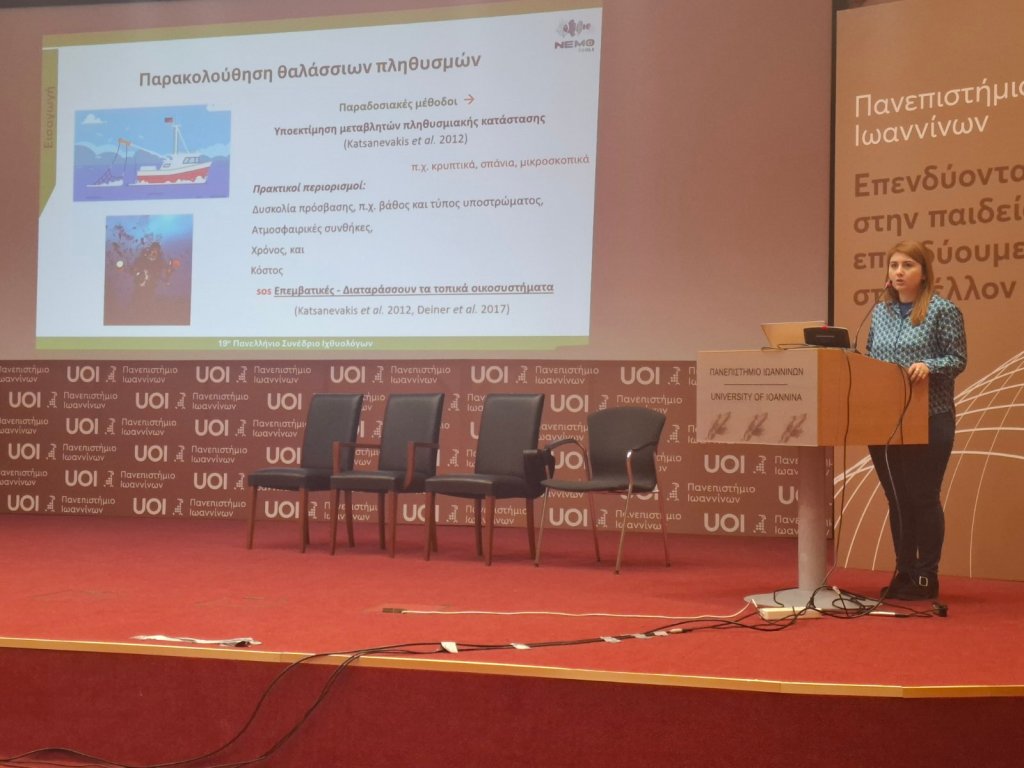
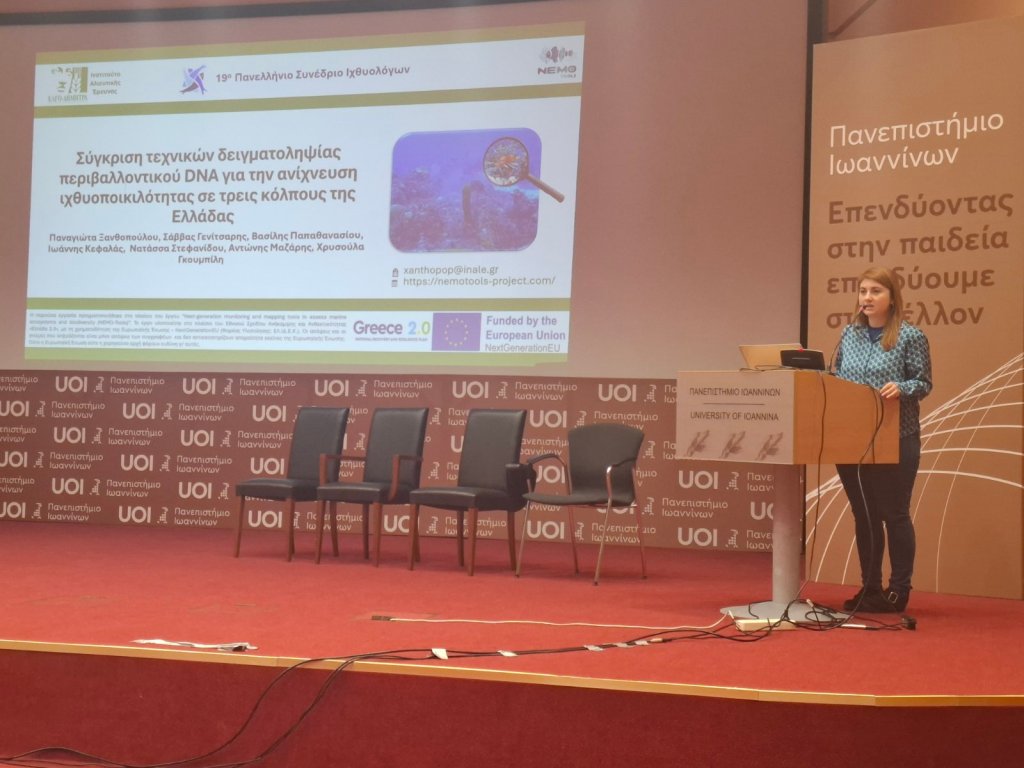
The NEMO-Tools project made a significant contribution to the 19th Hellenic Conference of Ichthyologists, held in Ioannina, Greece, from October 30 to November 2, 2025. Team member and researcher Panagiota Xanthopoulou represented the project with an oral presentation titled “Assessing different eDNA sampling techniques for fish community detection in gulfs of Greece.”
The presentation showcased how environmental DNA (eDNA) metabarcoding can be used as an effective, non-invasive method for biomonitoring fish biodiversity in coastal ecosystems. The study compared three eDNA sampling approaches — vacuum pump filtering, passive eDNA collection with gauze rolls, and inline filtering — across three major Greek gulfs: Kavala, Saronikos, and Thermaikos.
Results revealed 22 fish species, with community composition varying among gulfs and depending on the sampling technique. Inline filtering produced the highest number of species records, followed by vacuum pump filtering, while passive gauze rolls yielded fewer detections. The findings underline that while eDNA is a powerful tool for biodiversity monitoring, the sampling method plays a crucial role in shaping results.
The conference gathered scientists and professionals from academia, research institutions, and environmental organizations to discuss advances in ichthyology, aquatic ecology, and sustainable management of marine and freshwater resources. Discussions emphasized the need to tackle challenges such as climate change, overfishing, habitat degradation, and pollution, and to promote innovative monitoring tools such as those developed within NEMO-Tools.
This participation highlights the project’s contribution to next-generation marine ecosystem monitoring and supports collaboration within Greece’s ichthyological and ecological research community.
 NEMO-Tools