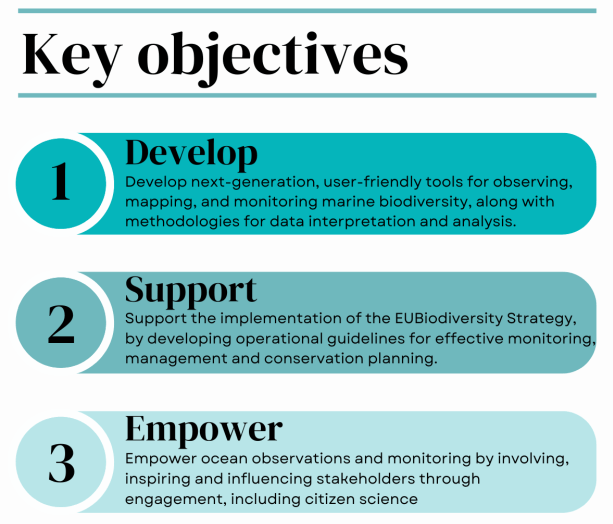
Key Objectives
What is our main challenge?
Coastal and marine ecosystems and their biodiversity are facing rapid changes and severe degradation due to global and local anthropogenic stressors, including the climate crisis. In response, the Green Deal and the EU Biodiversity Strategy for 2030 seeks to restore Europe’s biodiversity by 2030 for the benefit of people, the climate, and the planet. Achieving this depends on our ability to effectively measure, map, and monitor biodiversity and ecosystem functions across relevant taxonomic, temporal, and spatial scales, and to detect potential recoveries.
As these measurements are complex and costly, success greatly depends on advancing the state-of-the-art in effective and affordable methodologies and tools. Many advanced monitoring and computer technologies are now mature enough to be integrated with traditional methods to enhance ecological assessements of the oceans, but their full potential for biodiversity assessment can only be realized through comprehensive integration of these tools, platforms, and societal actions.
How does NEMO-Tools address this challenge?
NEMO-Tools, supporting the Green Deal and EU Biodiversity Strategy for 2030, addresses this challenge by taking an hierarchical approach to combine the required layers of information needed to produce an integrated, interoperable, affordable and harmonised set of tools and protocols for observing and mapping coastal and marine biodiversity. This project will expand the capabilities of existing scientific equipment and increase the efficiency of data acquisition systems at sea. Utilizing hard (ROVs, drones, Ground Unmanned Vehicle) and soft technologies (eDNA, AI), NEMO-Tools will produce innovative data-driven measures of biodiversity and ecosystem change at different spatiotemporal scales. Additionally, it aims to enhance community involvement and support in ocean observation and moniroting through citizen science initiatives.
NEMO-Tools Ambition
«To harness and combine all these advances and develop the next generation, fit-for-purpose, integrated observation, mapping and monitoring toolkit for marine ecosystems. These tools will provide scientists, managers, regulators, decision-makers, industries and the public the means to better understand ecological processes, the drivers of change and biodiversity decline, assess the effectiveness of mitigation measures and the path to recovery, and through that help achieve the goals of the EU Biodiversity Strategy.»
 NEMO-Tools