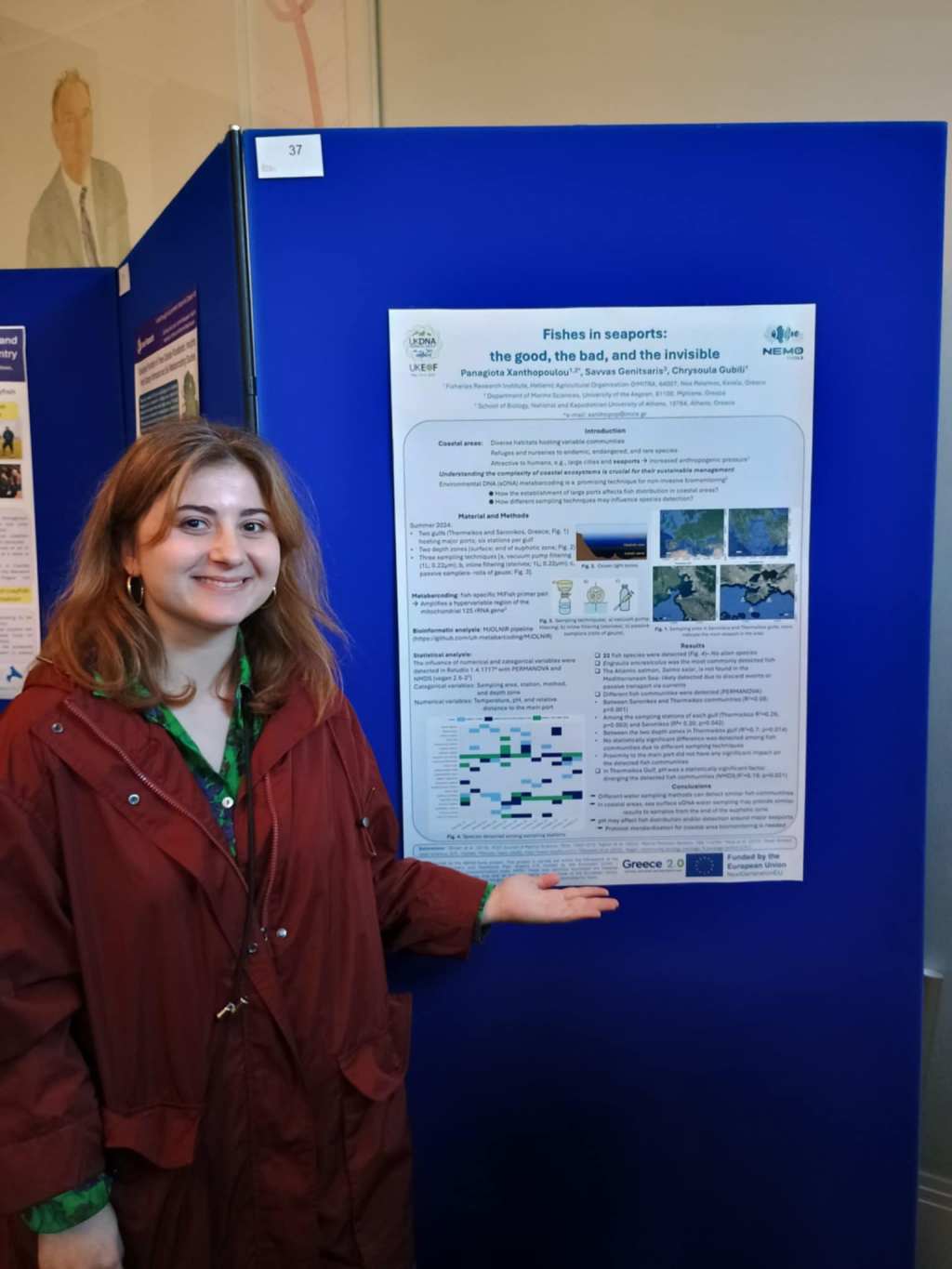
The Nemo-Tools project made a significant contribution to the 11th UKEOF UKDNA Working Group Conference, held on May 13-14, 2025, at the Royal Society. Team member and researcher Giota Xanthopoulou represented the project with a poster presentation, sharing key findings on the application of environmental DNA (eDNA) metabarcoding for coastal ecosystem monitoring.
The conference brought together an interdisciplinary community of policy makers, end-users, researchers, and eDNA service providers to explore the transformative potential of DNA-based methods in environmental monitoring and policy applications. The comprehensive agenda addressed cutting-edge topics including novel and emerging DNA-based technologies, health and forensic applications, and the critical challenges of operationalizing eDNA research.
Key conference themes included data standardization, FAIR (Findable, Accessible, Interoperable, Reusable) principles, and effective data mobilization strategies—all essential components for advancing the field of environmental DNA research.

Our project’s contribution focused on demonstrating how environmental DNA metabarcoding serves as a powerful, non-invasive biomonitoring technique for understanding the complexity of coastal ecosystems. This research is particularly valuable for sustainable coastal management, as it provides detailed insights into biodiversity patterns and ecosystem health without the need for traditional, more invasive sampling methods.
The conference provided an excellent platform to share our findings with the broader eDNA community and explore collaborative opportunities for advancing DNA-based environmental monitoring techniques across various applications and disciplines.

 NEMO-Tools